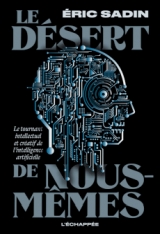
According to French philosopher Éric Sadin, a specialist in technology, the launch of ChatGPT on November 30, 2022, marks a profound turning point with far-reaching social and cultural consequences. AI systems claim to be capable of taking on more and more fundamental human capabilities, such as the production of language, images, and videos, but in reality, they are limited to the existing content used to train them.
Sadin’s direct critique targets every aspect of the systems that are being presented to us as AI. First and foremost, he questions how they function and their claim to produce intelligent content. ChatGPT and its counterparts cannot produce anything new; at best, they create new content based on the statistical frequency of word combinations. They lack the imagination that characterizes human beings, but the AI systems’ claim to be able to imitate it provokes Sadin’s scathing criticism.
The title of this book literally translates to “The Desert of Our Self,” which refers to our own fault—one for which Sadin reproaches us—because as soon as we consult AI, we abandon our creativity, our imagination, or even our sociability in favor of a machine that can only calculate content, but not imagine it.
He equates utilitarianism with a disease. In his view, this leads to our own alienation. The emergence of ChatGPT heralds a new era of artificial domination, a decoupling of humans from their world, and a negation of our very selves. In other words, automation neutralizes our abilities and seeks to take control of our creative capacities. Sadin speaks of our necrosis; avoiding it now would be the only way to preserve humanism.
See also:  Review: Éric Sadin, La vie spectrale. Thinking About the Age of the Metaverse and Generative AI
Sadin criticizes ChatGPT & Co. for suggesting that mechanical production can take on human traits, even though its output is based solely on associations and correlations. And Sadin refers to Paul Valéry, who stated at the Collège de France: “To create is to choose.” This unpredictability, which characterizes the creative act, is beyond the reach of ChatGPT & Co. Henri Bergson expressed a similar idea in *Creative Evolution* (1912), describing a creative impulse that brings forth the new and affirms freedom with every act—an impulse that Sadin contrasts with the language of machines: “We recognize the gigantic reductionist machine that is tainting our imagination…” (p. 48) and he recalls Charles Péguy, who declared: “There is something worse than a bad thought: having a preconceived thought…”
Sadin aims to show that the much-praised linguistic models thrive solely on constant plagiarism, through which they seek to prove their intelligence to us. He echoes Jacques Lacan: “When man forgets that he is the bearer of speech, he no longer speaks… When man no longer speaks, he is spoken.” Capitalist linguistics thus finds itself in the crosshairs of his relentless critique. “Generative artificial intelligence” would, above all, destroy our capacity for judgment. The evidence Sadin cites—from Günther Anders to David Graeber—underpins the theoretical foundation of his reflections.
According to Sadin, the most serious consequences will be felt as soon as AI is used in the field of education. Learning is linked to curiosity, the discovery of new things, and the willingness to change. With AI and the accompanying optimization of learning processes, utilitarianism becomes the sole guiding principle, supplanting the capacity for judgment, undermining social behavior, fostering self-sufficiency, and severing ties with our loved ones.
Sadin strongly opposes the automated generation of images and videos, which bypasses reality and leaves it to machines to interpret it. He accuses reality of being subjected to mathematical abstraction.
In the chapter “A World of Illusions,” Sadin traces the history of “social media,” which encourages the spread of pain, resentment, and hatred—and even “fake news”—thereby destroying the foundation of shared values.
The third chapter, “Toward the Complete Automation of Work,” is subtitled “A Crime Against Homo faber”: “How can we ignore the storm sweeping away professions that require highly developed cognitive skills? ” (p. 123) Sadin also takes aim at the distribution of iPads and laptops in schools, which are ill-suited to stimulating the curiosity of children eager to discover the world, but instead ruthlessly subject them to the long-awaited “digital transformation” industry (p. 124 ff.). Sadin paints a bleak picture of the future of the school system, which replaces teachers—who impart knowledge and encourage participation in collaborative projects—with AI applications, thereby stifling children’s abilities before they even have a chance to develop.
 See also: Review: Oliver Held, ChatGPT in History Class
Sadin goes even further and sees in AI’s increasingly intrusive claims a new “TOTAL POWER ” (p. 177), describing an omniscient power that intrudes everywhere, influences our actions, and thereby acquires political power. This is a process of dehumanization that relieves us of all effort and fosters the growing stupefaction of humanity. (p. 181
Creativity, autonomy, and even freedom are left by the wayside when we rely on AI. Our imagination and ingenuity atrophy when we abandon them to machines. Sadin strongly opposes this trend, which is not a democratically decided societal project but simply the expression of technical ambitions for power, and which requires a resolute defense of human capabilities.
One might think that Sadin is going too far with his diatribe, especially now that we’re being led to believe that the economy was just waiting for AI and that students are benefiting from new dimensions of learning thanks to it. But Sadin does not see these positive aspects. He takes aim at the ideology behind AI, at its desire to take control of our thoughts and decisions, and above all at our willingness to follow the siren call of AI. Technology beckons, and we abandon our freedom and our humanism—that is how one might summarize Sadin’s arguments. Is he, then, a voice in the wilderness, standing alone against all those who praise the new reality of AI? Not really, because with his nuanced reflections and deductions, he offers an important alternative to the overly one-sided praise of AI. His book is a significant contribution to the debate on the social consequences of the AI craze.
Selon le philosophe français Éric Sadin, spécialiste des technologies, le lancement de ChatGPT le 30 novembre 2022 marque un tournant profond aux conséquences sociales et culturelles considérables. Les systèmes d’IA prétendent être capables de prendre en charge de plus en plus de capacités humaines fondamentales telles que la production de langage, d’images et de vidéos, mais ils se limitent en réalité aux contenus existants qui ont servi à leur formation.
L’attaque frontale de Sadin vise tous les aspects des systèmes que l’on veut nous présenter comme de l’IA. Il remet tout d’abord en question leur fonctionnement et leur prétention à produire des contenus intelligents. ChatGPT et ses semblables ne peuvent rien produire de nouveau, ils créent tout au plus de nouveaux contenus sur la base de la fréquence statistique des combinaisons de mots. Ils sont dépourvus de l’imagination qui caractérise les êtres humains, mais la prétention des systèmes d’IA à vouloir l’imiter provoque la critique virulente de Sadin.
Le titre de ce livre se traduit littéralement par « Le désert de notre moi », ce qui fait référence à notre propre faute, que Sadin nous reproche, car dès que nous interrogeons l’IA, nous abandonnons notre créativité, notre imagination ou même notre sociabilité au profit d’une machine qui ne peut que calculer des contenus, mais pas les imaginer.
Il associe l’utilitarisme à une maladie. Selon lui, cela conduit à une aliénation de nous-mêmes. L’apparition de ChatGPT annonce une nouvelle ère de domination artificielle, un découplage de l’homme et de son monde, une négation de nous-mêmes. En d’autres termes, l’automatisation neutralise nos capacités et veut prendre le contrôle de nos capacités créatives. Sadin parle de notre nécrose ; l’éviter maintenant serait la seule possibilité de préserver l’humanisme.
Siehe auch: Rezension: Éric Sadin, La vie spectrale. Penser l’ère du métavers et des IA génératives
Sadin reproche à ChatGPT & Co. de vouloir nous suggérer que la production mécanique peut prendre des traits humains, alors que son output ne repose que sur des associations et des corrélations. Et Sadin se réfère à Paul Valéry, qui a déclaré au Collège de France : « Créer, c’est choisir ». Cette imprévisibilité qui caractérise l’acte créatif est hors de portée de ChatGPT & Co. Henri Bergson s’est exprimé dans le même sens dans « L’évolution créatrice » (1912), un élan créatif qui crée du nouveau, confirme à chaque acte la liberté et que Sadin oppose au langage des machines : « On reconnaît la gigantesque machine réductionniste qui déteint sur notre imaginaire… » (p. 48) et il rappelle Charles Péguy, qui déclarait : « Il y a pire qu’une mauvaise pensée, c’est d’avoir une pensée préconçue… »
Sadin vise à montrer que les modèles linguistiques tant loués ne vivent que de plagiats constants, avec lesquels ils veulent nous prouver leur intelligence. Il rappelle Jacques Lacan : « Quand l’homme oublie qu’il porte la parole, il ne parle plus… Quand l’homme ne parle plus, il est parlé. » La linguistique capitaliste se retrouve ainsi dans le collimateur de sa critique impitoyable. L’« intelligence artificielle générative » détruirait avant tout notre capacité de jugement. Les preuves que Sadin cite, de Günther Anders à David Graeber, étayent le fondement théorique de ses réflexions.
Selon Sadin, les conséquences les plus graves se feront sentir dès que l’IA sera utilisée dans le domaine de l’éducation. L’apprentissage est lié à la curiosité, à la découverte de nouvelles choses et à la volonté de changer. Avec l’IA et l’optimisation des processus d’apprentissage qui l’accompagne, l’utilitarisme devient la seule ligne directrice, supplantant la capacité de jugement, nuisant au comportement social, entraînant l’autosuffisance et coupant les liens avec nos proches.
Sadin s’oppose avec force à la création automatique d’images et de vidéos, qui contourne la réalité et laisse aux machines le soin de l’interpréter. Il accuse la réalité d’être soumise à une abstraction mathématique.
Dans le chapitre « Un monde d’illusions », Sadin retrace l’histoire des « réseaux sociaux », qui incitent à répandre la douleur, la rancœur et la haine, voire des « fake news », ce qui a pour conséquence la destruction du socle de valeurs communes.
Le troisième chapitre, « Vers une automatisation intégrale du travail », a pour sous-titre « Un crime contre l’Homo faber » : « Comment ignorer la tempête qui balaye les professions exigeant des compétences cognitives hautement développées ? » (p. 123) Sadin vise également la distribution d’iPads et d’ordinateurs portables dans les écoles, qui ne sont guère adaptés pour stimuler la curiosité des enfants désireux de découvrir le monde, mais les soumettent impitoyablement à l’industrie de la « transformation numérique » tant attendue (p. 124 et suivantes). Sadin dresse un tableau sombre de l’avenir de l’institution scolaire, qui remplace l’enseignant, qui transmet les connaissances et encourage la participation à des projets communs, par des applications d’IA et étouffe les capacités des enfants dans l’œuf.
Siehe auch: Rezension: Oliver Held, ChatGPT im Geschichtsunterricht
Sadin va encore plus loin et voit dans les prétentions de plus en plus envahissantes de l’IA un nouveau « POUVOIR TOTAL » (p. 177), décrivant ainsi un pouvoir omniscient qui s’immisce partout, influence nos actions et acquiert ainsi un pouvoir politique. Il s’agit d’un processus de déshumanisation qui nous dispense de tout effort et favorise l’abrutissement croissant de l’humanité. (p. 181
La créativité, l’autonomie, voire la liberté, sont laissées pour compte lorsque nous nous en remettons à l’IA. Notre imagination et notre ingéniosité s’atrophient lorsque nous les abandonnons aux machines. Sadin s’oppose fermement à cette évolution, qui n’est pas un projet de société décidé démocratiquement, mais simplement l’expression d’ambitions techniques de pouvoir, et qui nécessite une défense résolue des capacités humaines.
On pourrait penser que Sadin va trop loin avec sa diatribe, surtout maintenant que l’on nous donne l’impression que l’économie n’attendait que l’IA et que les élèves profitent de nouvelles dimensions d’apprentissage grâce à elle. Mais Sadin ne voit pas ces aspects positifs. Il s’en prend à l’imaginaire qui se cache derrière l’IA, à sa volonté de prendre le contrôle de notre pensée et de nos décisions, et surtout à notre disposition à suivre les sirènes de l’IA. La technologie nous appelle et nous abandonnons notre liberté et notre humanisme, voilà comment on pourrait résumer les thèses de Sadin. Est-il donc une voix dans le désert, seul face à tous ceux qui louent la nouvelle réalité de l’IA ? Pas vraiment, car avec ses réflexions et ses déductions nuancées, il présente une alternative importante aux éloges trop unilatéraux de l’IA. Son livre est une contribution importante au débat sur les conséquences sociales de l’engouement pour l’IA.
Die Einführung von ChatGPT am 30.November 2022 stehe, so der französische Technikphilosoph Éric Sadin, für eine tiefgreifende Wende mit weitreichenden sozialen und kulturellen Folgen. KI-Systeme gäben vor, zunehmend grundlegende menschliche Fähigkeiten wie die Produktion von Sprache, Bildern und Videos übernehmen zu können, und sie beschränken sich doch nur auf bereits vorhandene Inhalte, die zu ihrem Training gedient haben.
Sadins Frontalangriff richtet sich gegen alle Aspekte der Systeme, die man uns als KI vorsetzen will. Zunächst stellt er deren Funktionsweise und ihren Anspruch, intelligente Inhalte zu produzieren in Frage. ChatGPT und Co. könnten nichts Neues produzieren, sie schaffen allenfalls neue Inhalte auf der Basis der statistischen Häufigkeit von Wortverbindungen. Die Imagination, die den Menschen auszeichnet, geht ihnen ab, aber der Anspruch der KI-Systeme, sie imitieren zu wollen, provoziert die entschiedene Kritik von Sadin.
Der Titel dieses Buches lautet wörtlich übersetzt „Die Wüste unseres Selbst“, das bezieht sich auf unser Selbstverschulden, das Sadin uns vorwirft, denn sowie wir die KI befragen, geben wir unsere Kreativität, Imagination oder auch Geselligkeit auf zugunsten einer Maschine, die Inhalte nur ausrechnen, aber nicht ausdenken kann.
Den Utilitarismus verbindet er mit einer Krankheit. Er führe zu einer Entfremdung von uns selbst. Das Erscheinen von ChatGPT verkündet die neue Ära einer künstlichen Herrschaft, eine Entkoppelung des Menschen von seiner Welt, eine Verneinung von uns selbst. Mit anderen Worten, die Automatisierung neutralisiert unsere Fähigkeiten und sie will unsere schöpferischen Fähigkeiten übernehmen. Sadin spricht von unserer Nekrose; sie jetzt noch zu vermeiden, sei die einzige Möglichkeit an einem Humanismus festzuhalten.
Siehe auch: Rezension: Éric Sadin, La vie spectrale. Penser l’ère du métavers et des IA génératives
Sadin wirft ChatGPT & Co. vor, uns suggerieren zu wollen, das die maschinelle Produktion menschliche Züge annehmen könne, wo doch ihr Output nur auf Assoziation und Korrelationen beruhe. Und Sadin beruft sich auf Paul Valéry, der im Collège de France sagte, „Schöpfen, das bedeute wählen“. Diese Unvorherbestimmt, die den schöpferischen Akt auszeichnet, ist außer Reichweite von ChatGPT & Co. Genauso äußerte sich Henri Bergson in „Die schöpferische Entwicklung,“ (1912), ein kreativer Elan, der Neues schafft, mit jedem Akt die Freiheit von neuem bestätigt und den Sadin der Maschinensprache gegenüberstellt: „Erkennt man die gigantische reduktionistische Maschine, die auf unsere Vorstellungswelt abfärbt…“ (S. 48) und er erinnert an Charles Péguy, der erklärte: „Es gibt etwas Schlimmeres als einen schlechten Gedanken, das ist eine vorgefassten Gedanken zu haben…“ Sadin zielt darauf ab, dass die so gelobten Sprachmodelle nur von ständigen Plagiaten leben, mit denen sie uns ihre Intelligenz beweisen wollen. Er erinnert an Jaques Lacan: „Wenn der Mensch vergisst, dass er die Sprache trägt, spricht er nicht mehr… Wenn der Mensch nicht mehr spricht, wird er gesprochen.“ Damit gerät die kapitalistische Linguistik in das Fadenkreuz seiner unbarmherzigen Kritik. Die sog. „generative künstliche Intelligenz“ werde in erster Linie unser Urteilsvermögen zerstören. Die Belege, die Sadin von Günther Anders bis David Graeber anführt, belegen die theoretische Grundlage seiner Reflexionen.
Am schwerwiegendsten sind, so Sadin, die Folgen, sobald die KI im Bereich der Bildung eingesetzt werde. Lernen habe etwas mit Neugier zu tun, Neues zu entdecken und der Bereitschaft, sich zu verändern. Mit der KI und der damit einhergehenden Optimierung von Lernprozessen wird der Utilitarismus zur alleinigen Richtline, die das Urteilsvermögen verdrängt, das soziale Verhalten beschädigt, Selbstgenügsamkeit bewirkt und die Verbindungen zu unseren Nächsten kappt.
Besonders nachdrücklich wendet sich Sadin gegen die automatische Bild- und Videoerstellung, mit der die Wirklichkeit umgangen werde und man den Maschinen die Interpretation der Wirklichkeit überlasse. Die Wirklichkeit werde einer mathematischen Abstraktion unterworfen, so lautet seine Anklage.
Im Kapitel „Eine Welt der Hirngespinste“ entwickelt Sadin eine Geschichte der „sozialen Netzwerke“, die dazu verführen, Schmerzen, Groll und Hass bis hin zu „fake news“ zu verbreiten, die Folge ist die Zerstörung der gemeinsamen Wertebasis. Das dritte Kapitel „Hin zu einer integralen Automatisierung der Arbeit“ hat den Untertitel „Ein Verbrechen gegen den Homo faber“: „Wie sollte man den Sturm übersehen, der über die Berufe mit kognitiv hoch entwickelten Kompetenzen hinwegfegt?“ (S. 123) Worauf Sadin zielt ist auch die Verteilung von IPads und Laptops in Schulen, die kaum geeignet sind, die Neugier von Kindern, die die Welt entdecken wollen, zu fördern, sondern sie unbarmherzig wie auch die Industrie der so ersehnten „digitalen Transformation“ (S.124 f) unterwirft. Sadin zeichnet ein düsteres Bild der Zukunft der Institution Schule, die den Lehrer, der das Wissen vermittelt und die Teilhabe an gemeinsamen Projekten fördert, durch KI-Anwendungen ersetzt und die Fähigkeiten der Kinder im Keim erstickt.
Siehe auch: Rezension: Oliver Held, ChatGPT im Geschichtsunterricht
Sadin geht noch weiter und sieht in den immer mehr um sich greifenden Anmaßungen der KI eine neue „TOTALE MACHT“ (S. 177) und umschreibt damit eine allwissende Macht, die sich überall einmischt, die unsere Handlungen beeinflusst und so auch eine politische Macht erringt. Es ist ein Prozess der Deshumanisierung, der uns jedwede Anstrengung abnimmt und die wachsende Verdummung der Menschheit vorantreibt. (S. 181
Die Kreativität, die Autonomie, ja auch die Freiheit bleiben auf der Strecke, wenn wir uns der KI anvertrauen. Unsere Imagination und unser Einfallsreichtum verkümmern, wenn wir sie den Maschinen überlassen. Sadin wendet sich mit Nachdruck gegen diese Entwicklung, die kein demokratisch beschlossenes Gesellschaftsprojekt sei, sondern lediglich Ausdruck technischer Machtambitionen und erfordert eine entschlossene Verteidigung menschlicher Fähigkeiten.
Man könnte meinen, Sadin schießt mit einer Philippika über das Ziel hinaus, gerade jetzt, wo uns das Gefühl gegeben wird, die Wirtschaft habe nur auf die KI gewartet und Schüler genießen neue Lerndimensionen dank der KI. Aber derlei positive Aspekte vermag Sadin nicht zu erkennen. Er greift die Vorstellungswelt hinter der KI an, ihr Ansinnen, unser Denken und unsere Entscheidungen übernehmen zu wollen, und vor allem aber unsere Bereitschaft, den Sirenenklängen der KI zu folgen. Die Technik ruft und wir geben unsere Freiheit und unseren Humanismus auf, so könnte man die Thesen von Sadin zusammenfassen. Ist er damit ein Rufer in der Wüste, allein auf sich gestellt gegenüber allen denjenigen, die neue Wirklichkeit der KI in den höchsten Tönen loben? Kaum, denn mit seinen differenzierten Überlegungen und Herleitungen legt er einen wichtigen Gegenentwurf zu den zu einseitigen Lobeshymnen gegenüber der KI vor. Sein Buch ist ein wichtiger Beitrag zur Diskussion hinsichtlich der gesellschaftlichen Folgen des KI-Hypes.
Übersetzungen mit der Unterstützung von www.deepl.com.
Eric Sadin, Le Désert de nous-mêmes: Le tournant intellectuel et créatif de l’intelligence artificielle, Paris: L’Èchapée 2025. 19 €
> Die Beiträge unserer Redaktion zur KI – www.france-blog.info