


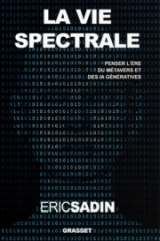
Éric Sadin’s book, La vie spectrale. Thinking About the Era of the Metaverse and Generative AI has just been published. Sadin presents a critical examination of the Metaverse and “Generative Artificial Intelligence,” such as that released by OpenAI in late 2023 with ChatGPT. The term Metaverse refers to a virtual environment—a virtual economy—in which a digital currency exists and which operates using “non-fungible tokens” (NFTs), which are digital certificates representing the authenticity of a digital file and proving its authenticity. So much for the subtitle of this book, whose title, Spectral Life, traces a remarkable spectrum leading all the way to phantom life. The same is true of the book’s content and the author’s argument: what enormous leaps forward have we not made—from the personal computer to the Internet, then to the smartphone, via Web 2.0, all the way to the emergence of AI for everyone—along with an enormous promise for the future, so that we’ll all soon find ourselves in the metaverse, including the refrigerator that, once a week, thanks to its AI, knows what’s good for us and places the order on our behalf.
Just as the emergence of ChatGPT is exciting many teacher training programs and new applications are constantly being devised for school instruction, so too in France must all students have access to AI for their homework: > The Introduction of AI in French Schools – Frankreich-Blog, January 2, 2024.
This triumphant march of AI is also reflected in new (paid) applications that help cement the highly positive image of AI, which promises numerous simplifications in all areas of life and leads us to believe that AI can provide us with new ideas. And yet, ChatGPT itself is so modest and does not claim to exist in isolation. Question for ChatGPT: “Is there such a thing as AI without algorithms?” The answer (January 19, 2024): “No, artificial intelligence (AI) is fundamentally based on algorithms. An algorithm is essentially a systematic series of instructions or rules executed by a computer or software to solve a specific task or achieve a given objective. These algorithms are used to identify patterns in data, train models, and ultimately make decisions or predictions.” Of course, one can debate at length the extent to which AI is actually possible… But it’s enough here to see the sparkle in the eyes of all those who claim there’s AI in my GPS and all the others who rave about AI and neural networks to perhaps appear a little skeptical.
And this is precisely where Sadin directs his criticism. He views the consequences of this rapid technological evolution as a “surrender of ourselves” (p. 205). Just look at the multitude of screens that feed us information—one might even say that they choose it for us; at least this is true of social media —stuttgart-fotos.de, which he considers extremely harmful: “our absorption into a universe that redefines—always to our advantage—our relationships with others and with reality.” (p. 206) He thus summarizes in a single sentence his fundamental critique of the entire development of AI. See: Eris Sadin, Artificial Intelligence or the Challenge of the Century: Anatomy of a Radical Anti-Humanism, Paris: Éditions L’Échapée, 2021. Everything comes together: the ever-increasing speed at which information is presented to us and the ever-changing instructions that are meant to compel us to adopt certain behaviors. (see p. 15)
For Sadin, the Metaverse is a new dimension of a “phantom society” (p. 18) that suggests a constant presence: nothing but advertising designed to make us function ever more efficiently. This ushers in the era of “digital fundamentalism” (p. 25), which positions us as the center of the world and, in the process, destroys all social contact. (see p. 37): “… the ancestral purpose of our body and mind, leading, as a corollary, to a complete redefinition of our existential framework.” (p. 41).
Sadin is particularly outraged by the fact that none of these milestones in the development of online technology—up to and including AI—has given rise to a social dialogue. The results are imposed on us; there is little way to escape them. (see p. 47) And in doing so, a form of personalization is suggested that is nothing more than a “cage of pixels populated by ghosts” (p. 135), freely inspired by Max Weber.
Under the heading “Curtain Call on the Arts of Doing,” the focus is on “the fractal dimension at work between technology, the body, and society.” (p. 59) This analysis portends the worst; here, we can only analyze its dire consequences. Among its proponents—such as Tocqueville, Baudrillard, Kant, McLuhan La Mettrie also appears, who, in 1741, in *L’homme machine*, compares man to a machine—not in the sense of modern AI, but as a man who creates his own motivations from within himself (see p. 60)—and this is precisely what AI not only calls into question but destroys.
An important passage is devoted less to working with the keyboard than to “fiery pixels”—the pixelation of life. This is how Sadin refers to the ubiquitous screens of all kinds, the omnipresence of pixels, which Günther Anders—whom Sadin also cites—had always had in mind: In his words, this already concerns what is socially so questionable: the “compartmentalization among people working in the same place.” (p. 79) This is also called “interactivity” (p. 82), with the author here as well having in mind all the forms of passivity that result from it. Profit is maximized by our passivity, to summarize Sadin here. People are, in a sense, glued to the screen. (p. 94 ff.) One of the author’s theses is as follows: “A fundamentally unnatural philosophy of existence is bound to prevail.” (p. 101) The consequence is a “prefabricated reality” (p. 103), which is obviously not progress at all in Sadin’s view, for, as he puts it later, “the algorithmic and pixelated personalization of our relationship to the world muzzles our capacity for action, which depends on the exercise of our judgment and engages our conscience and responsibility.” (p. 134 ff.) This is expressed very precisely and addresses the question of whether PC and Internet technology offer better opportunities for learning: > Essay on the subject. Learning and Studying with the Internet, Frankreich-Blog, September 30, 2016.
One might rightly object here that Sadin’s critique does not necessarily call into question studying with the help of computers and the Internet, but that for the author, the issue is a much more fundamental one: how many students seek information on their subjects online instead of reading books—the primary sources: Summaries found online or using ChatGPT are sometimes irrelevant: Louis Aragon, *La Semaine sainte*, Frankreich-Blog, November 4, 2023 (Please read the French version of the response to the request to summarize *La Semaine sainte*. Please click on the tricolor flag.). To illustrate his point, Sadin quotes Kant’s essay What Is Enlightenment?, in which Kant describes relying on others as a form of renunciation—a way to avoid the effort of thinking. (see p. 134) “Our imagination is losing its substance…” (p. 136) and Sadin recalls Jean-Paul Sartre, who wrote in *em* *L’Imaginaire*. “The imagination reveals human freedom.” This provides Sadin with an opportunity to sharpen his critique: one might get the impression that in the past we were able to study in a more focused way; today, a student said she couldn’t write her seminar paper on Balzac because she hadn’t found anything on the Internet about the subject.
It’s not just the thousands of distractions—everything that tries to capture our attention online—but above all the illusion of offering everything that makes the internet so alluring. We pretend we’re in a public space, as social media suggests a public sphere while subjecting its users to strict rules. “Widespread Telesociality” is therefore the title of the following chapter: “Solitary Isolation” (p. 177) follows as a keyword. This could only have happened because the renunciation of ourselves goes hand in hand with the erasure of our responsibility. Sadin cites ChatGPT and criticizes, first and foremost, the fact that this system assumes the right to generate language on our behalf.
Everyone knows that this AI has been able to string words together based on context according to a principle of probability and that it claims to be able to learn using neural networks. Creativity and singularity are left by the wayside (see pp. 214, 229). The consequence, as Sadin puts it: “Humanity’s ‘becoming a vegetable’” (p. 217) … and the teacher becomes a coach and misses the opportunity to teach students a culture of critical thinking (see p. 224). Chat ACC, “Cultural and Civilizational Abjection”—that is what Sadin would like to call AI.
How should we evaluate Sadin’s critique? Well, he highlights the “systematic reshaping of behavior” (p. 256) and thus touches on the core of the constant allure exerted by the Internet—or, in other words, we are subjected to constant marketing and must perform ever better. Data protection (General Data Protection Regulation, GDPR) on the one hand, and cookies that spy on our behavior on the other—these two things don’t go together. A student told me that he spent an average of 8 to 9 hours on TikTok over the past eight days.
Emanuel Macron was very clear in his press conference on January 16, 2024, he announced that a commission of experts would study screen use and pointed out that a great deal of information comes from all sides and is accepted without being verified, which leads to conspiracy theories. Indeed, opinions, critiques, and stances of all kinds are increasingly treated as news, much like Wikipedia—where numerous anonymous authors and editors contribute—or ChatGPT, which provides us with texts whose sources are not disclosed. But we can also observe how the almost addictive use of the Internet encourages students to disconnect from reality and miss opportunities to stay informed about current events. It is this voluntary submission to the Internet’s unwritten but implied rules—particularly those of social media—that Sadin rightly targets in his fundamental critique. It is an illusion to think that ChatGPT can even remotely replace creativity and imagination; it is the pretense of being able to do so—which ChatGPT and its counterparts dangle before us with their “natural language”—that makes these AI systems so dangerous, according to Sadin.
Le livre d’Éric Sadin, La vie spectrale. Penser l’ère du métavers et des IA génératives vient de paraître. Sadin présente un examen critique du Metavers et de l'“Intelligence Artificielle Générative“, telle que l’a par exemple publiée OpenAI fin 2023 avec ChatGPT. L’expression Metavers désigne un environnement virtuel, une économie virtuelle, dans laquelle il existe une monnaie numérique et qui fonctionne avec des „jetons non fongibles“ (NFT), qui sont des certificats numériques représentant l’authenticité d’un fichier numérique et prouvant son authenticité. Voilà pour le sous-titre de ce livre, dont le titre, La vie spectrale passe par un spectre remarquable jusqu’à la vie fantôme. Il en va de même pour le contenu de ce livre et l’argumentation de l’auteur : que n’a-t-on pas fait d’énormes bonds en avant, de l’ordinateur personnel à l’Internet, puis au smartphone, en passant par le web 2.0, jusqu’à l’apparition de l’IA pour tout le monde – en même temps qu’une énorme promesse pour l’avenir, afin que nous nous retrouvions tous bientôt dans le métavers, y compris le réfrigérateur qui, une fois par semaine, grâce à son IA, sait ce qui est bon pour nous et exécute la commande à notre place.
De même que l’apparition de ChatGPT enthousiasme de nombreuses formations d’enseignants et que de nouvelles applications sont sans cesse imaginées pour l’enseignement scolaire, de même qu’en France tous les élèves doivent avoir accès à l’IA pour les devoirs : > L’introduction de l’IA dans les écoles en France – Frankreich-Blog, 2. Januar 2024.
Cette marche triomphale de l’IA se traduit également par de nouvelles applications (payantes) qui contribuent à cimenter le terme si positif d’IA, qui promet de nombreuses simplifications dans tous les domaines de la vie et fait croire que l’IA peut nous apporter de nouvelles idées. Et pourtant, ChatGPT est lui-même si modeste et ne revendique pas une existence solitaire. Question à CHatGPT : „Existe-t-il une IA sans alogrithmes ?“ La réponse (19.1.2024) : „Non, l’intelligence artificielle (IA) est fondamentalement basée sur des algorithmes. Un algorithme est essentiellement une série systématique d’instructions ou de règles exécutées par un ordinateur ou un logiciel afin de résoudre une tâche spécifique ou d’atteindre un objectif donné. Ces algorithmes sont utilisés pour identifier des modèles dans les données, former des modèles et finalement prendre des décisions ou faire des prédictions“. On peut bien sûr discuter à loisir de la mesure dans laquelle l’IA est possible… Assez, il suffit ici de voir briller les yeux de tous ceux qui disent qu’il y a de l’IA dans mon GPS et de tous les autres qui s’extasient devant l’IA et les réseaux neuronaux pour paraître peut-être un peu sceptiques.
Et c’est précisément là que Sadin place sa critique. Il considère les conséquences de cette évolution technique fulgurante comme une „démission de nous-mêmes“ (p. 205). Rien que la multiplicité des écrans qui nous transmettent des informations, on aimerait dire qui les choisissent pour nous, du moins c’est vrai pour les réseaux sociaux – stuttgart-fotos.de, qu’il considère comme extrêmement nuisible: notre absorption dans un univers redéfinissant – toujours à notre avantage – nos rapports aux autres et au réel.“ (S. 206) Il résume ainsi en une phrase sa critique fondamentale de l’ensemble du développement de l’IA. Cf: Eris Sadin, Intelligence artificielle ou l’Enjeu du siècle. Anatomie d’un antihumanisme radical, Paris: Éditions L’Échapée 2021. Tout se combine, la vitesse toujours croissante à laquelle les informations nous sont présentées et les instructions toujours nouvelles qui doivent nous obliger à adopter certains comportements. (cf. p. 15)
Metavers est pour Sadin une nouvelle dimension d’une „société fantôme“ (p. 18) qui nous suggère une proximité permanente : uniquement de la publicité pour que nous fonctionnions toujours mieux. S’ouvre alors l’ère de l'“intégralisme numérique“ (p. 25), qui nous suggère comme le centre du monde et détruit au passage tous les contacts sociaux. (cf. p. 37) : „… la vocation ancestrale de notre corps et de notre esprit, entraînant, de fait corollaire, une redéfinition complète de notre cadre existentiel.“ (p. 41).
Sadin se montre particulièrement indigné par le fait qu’aucun de ces jalons dans le développement de la technologie en ligne jusqu’à l’IA n’a donné lieu à un dialogue social. Les résultats nous sont imposés, il n’est guère possible d’y échapper. (cf. p. 47) Et ce faisant, on suggère une personnalisation qui n’est rien d’autre qu’une „cage de pixels peuplée de fantômes“ (p. 135), librement inspirée de Max Weber.
Sous le titre „Baisser de rideau sur les arts de faire“, il s’agit de „la dimension fractale qui est à l’œuvre entre technologie, corps et société.“ (p. 59) Cette analyse laisse présager le pire, on ne peut ici qu’en analyser les funestes conséquences. Parmi ses garants comme Tocqueville, Baudrillard, Kant, McLuhan apparaît également La Mettrie qui, en 1741, dans L’homme machine, compare l’homme à une machine, non pas dans le sens d’une IA actuelle, mais comme un homme qui crée ses motivations à partir de lui-même (cf. p. 60) et c’est précisément ce que l’IA ne fait pas que remettre en question, mais détruit.
Un passage important est consacré moins au travail avec le clavier qu’aux „pixels ardents“, la pixellisation de la vie, c’est ainsi que Sadin appelle les écrans omniprésents de toutes sortes, l’omniprésence des pixels, que Günther Anders, que Sadin cite également, avait déjà toujours en tête : Dans son langage, il s’agit déjà de ce qui est socialement si discutable, le „cloisonnement entre personnes exerçant sur un même lieu“. (p. 79) On appelle aussi cela „interactivité“ (p. 82), l’auteur ayant ici aussi en vue toutes les formes de passivité qui en résultent. Le profit est optimisé par notre passivité, peut-on résumer ici Sadin. L’homme est fixé d’une certaine manière devant l’écran. (p. 94 s.) L’une des thèses de l’auteur est la suivante : „Une philosophie foncièrement antinaturelle de l’existence est promise à s’imposer“. (p. 101) La conséquence un „réel préfabriqué“ (p. 103), ce qui n’est évidemment pas du tout un progrès dans l’esprit de Sadin, car, comme il le formule plus tard, „la personnalisation algorithmique et pixellisée de notre rapport au monde muselle notre puissance agissante, qui dépend de l’exercice de notre jugement et engage notre conscience et notre responsabilité“. (p. 134 s.) C’est exprimé de manière très précise et répond à la question de savoir si la technologie du PC et Internet permettent de meilleures possibilités d’études : > Essai sur le sujet. Apprendre et étudier avec Internet, Frankreich-Blog, 30 septembre 2016.
On objectera ici à juste titre que la critique de Sadin ne remet pas forcément en question les études avec l’aide de l’ordinateur et d’Internet, mais qu’il s’agit pour l’auteur d’une question beaucoup plus fondamentale : combien d’élèves et d’étudiants cherchent des informations sur leurs sujets sur Internet au lieu de lire les livres, la littérature primaire : Les résumés trouvés sur Internet ou à l’aide de ChatGPT ne sont parfois pas pertinents : Louis Aragon, La Semaine sainte, Frankreich-Blog, 4 novembre 2023 (Veuillez lire la version française de la réponse à la demande de résumer de „Semaine Sainte“. Veuillez cliquer sur le drapeau tricolore.). Pour illustrer sa pensée, Sadin cite l’essai de Kant Qu’est-ce que l’Aufklärung?, dans lequel il qualifie de renoncement le fait de s’en remettre à autrui comme étant si simple et le contournement de la fatigue, on n’a pas besoin de penser. (cf. p. 134) „Notre imaginaire perd de sa substance…“ (p. 136) et Sadin rappelle Jean-Paul Sartre qui écrivait dans L’Imaginaire. „L’imaginare révèle la liberté de l’homme“. C’est une occasion pour Sadin d’accentuer sa crtique: on pourrait avoir l’impression qu’avant nous pouvions étudier de manière plus ciblée, aujourd’hui une étudiante a dit qu’elle ne pouvait pas écrire son travail de séminaire sur Balzac parce qu’elle n’avait rien trouvé sur Internet à ce sujet.
Ce ne sont pas seulement les milliers de distractions, tout ce qui tente de capter notre attention sur le réseau, c’est surtout l’illusion d’offrir tout ce qui rend le réseau si séduisant. On fait semblant si nous étions sur un un lieu public, comme réseau sociaux suggérer le public tout en soumettant ses utilisateurs à des règles strictes. „La Télesocialité généralisée“ est donc le titre du chapitre suivant : „Isolement solitaire„, (p. 177), suit ensuite comme mot-clé. Cela n’a pu se produire que parce que le renoncement à nous-mêmes s’accompagne de l’effacement de notre responsabilité. Sadin cite ChatGPT et critique en premier lieu le fait que ce système s’arroge le droit de produire du langage à notre place.
Tout le monde sait que cette IA a pu aligner des mots en fonction du contexte selon un principe de probabilité et qu’elle prétend pouvoir apprendre avec des réseaux neuronaux. La créativité et la singularité sont laissées de côté (cf. p. 214, 229). La conséquence, comme le formule Sadin : „Le ‚Devenir-légume‘ de l’humanité“ (p. 217)… et l’enseignant devient un coach et rate l’occasion d’enseigner à ses élèves une culture de la critique (cf. p. 224) Chat ACC, „abjection Culturelle et Civilisationnelle„, c’est ainsi que Sadin aimerait appeler l’IA.
Comment évaluer la critique de Sadin ? Eh bien, il souligne l'“infléchissement systématisé des conduites“ (p. 256) et touche ainsi au cœur de la séduction permanente exercée par Internet, ou, en d’autres termes, nous sommes soumis au marketing permanent et devons fonctionner toujours mieux. La protection des données (Règlement général sur la protection des données RGPD) d’une part et d’autre partles des cookies qui espionnent notre comportement ; tout cela ne va pas ensemble. Un élève me dit qu’il a passé en moyenne 8 à 9 heures sur TikTok au cours des huit derniers jours.
Emanuel Macron a été très clair dans sa conférence de presse du 16 janvier 2024, il a annoncé l’étude d’une commission d’experts sur l’utilisation des écrans et a rappelé que beaucoup d’informations venaient de tous les côtés et étaient reçues sans être vérifiées, que cela conduisait à des théories du complot. En effet, les opinions, les critiques, les prises de position de toutes sortes sont de plus en plus considérées comme des nouvelles, à l’instar de Wikipédia où circulent de nombreux auteurs et correcteurs anonymes, ou du chat GPT qui nous fournit des textes dont les sources sont passées sous silence. Mais on peut aussi observer comment l’utilisation presque addictive d’Internet incite les élèves à se couper de la réalité et à laisser passer les occasions de s’informer sur l’actualité. C’est cette soumission volontaire aux règles non fixées mais suggérées d’Internet, en particulier des réseaux sociaux, que Sadin vise à juste titre dans sa critique fondamentale. C’est une illusion que ChatGPT puisse remplacer, même de loin, la créativité et l’imagination, c’est la prétention de pouvoir le faire que ChatGPT et consorts nous font miroiter avec leur „langage naturel“ qui rend ces systèmes d’IA si dangereux selon Sadin.
Gerade ist der Band von Éric Sadin, La vie spectrale. Penser l’ère du métavers et des IA génératives erschienen. Sadin legt eine kritische Betrachtung des Metaverse und der „Generativen Künstlichen Intelligenz“ vor, so wie sie z. B. OpenAI Ende 2023 mit ChatGPT veröffentlicht hat. Mit dem Ausdruck Metaverse wird wird eine virtuelle Umgebung, eine virtuelle Wirtschaft bezeichnet, in der es eine digitale Währung gibt und die mit NFT „Non-fungible Token“ funktioniert, die als digitale Zertifikate, die die Echtheit einer digitalen Datei repräsentieren und deren Echtheit belegen. Soweit zum Untertitel dieses Buches, dessen Titel, La vie spectrale von einem bemerkenswerten Spektrum bis zum Geisterleben reicht. So auch der Inhalt dieses Buches und die Argumentation des Autors: Was hat die Entwicklung vom Personal Computer, über das Internet und dann das Smartphone, über Web 2.0 bis zum Erschienen der KI für jedermann nicht für gewaltige Sprünge gemacht – zugleich mit einem gewaltigen Versprechen für die Zukunft, auf dass wir alle uns bald in der Metaverse wiederfinden, einschließlich des Kühlschranks der einmal in der Woche aufgrund seiner KI weiß, was für uns gut ist und die Bestellung stellvertretend für uns ausführt.
So wie das Erscheinen von ChatGPT viele Lehrerfortbildungen begeistert und immer neue Anwendungen für den Schulunterricht erdacht werden, so wie in Frankreich alle Schüler Zugang zur KI bekommen sollen… für die Hausaufgaben: > Die Einführung der KI in den Schulen in Frankreich – Frankreich-Blog, 2. Januar 2024.
Dieser Siegeszug der KI zeigt sich auch in immer neuen (kostenpflichtigen) Anwendungen, die dazu beitragen, den so positiv besetzten Begriff der KI zu zementieren, der in allen Lebensbereichen viele Vereinfachungen verspricht und vorgaukelt, die KI könne uns neue Ideen bescheren. Und dabei ist ChatGPT selber so bescheiden und beansprucht keine Alleinexistenz für sich. Frage an CHatGPT: „Gibt es eine Ki ohne Alogrithmen?“ Die Antwort (19.1.2024): „Nein, künstliche Intelligenz (KI) basiert grundsätzlich auf Algorithmen. Ein Algorithmus ist im Wesentlichen eine systematische Reihe von Anweisungen oder Regeln, die von einem Computer oder einer Software ausgeführt werden, um eine bestimmte Aufgabe zu lösen oder ein bestimmtes Ziel zu erreichen. Diese Algorithmen werden dazu verwendet, Muster in Daten zu erkennen, Modelle zu trainieren und schließlich Entscheidungen oder Vorhersagen zu treffen.“ Natürlich kann man trefflich diskutieren, inwieweit KI überhaupt möglich sei… Genug, es reicht hier das Leuchten in den Augen aller derjenigen, die sagen, in meinem Navi steckt KI und aller anderen, die von der KI und neuronalen Netzen schwärmen, um vielleicht doch ein wenig skeptisch zu werden.
Und genau hier setzt Sadin mit seiner Kritik an. Er hält die Folgen dieser technischen rasanten Entwicklung für eine „Demission unserer selbst“ (S. 205). Allein die Vielfalt der Bildschirme, die uns Informationen übermitteln, man möchte sagen, für uns aussuchen, zumindest gilt das für die sozialen Netzwerke – stuttgart-fotos.de, hält er für überaus schädlich: unsere Absorption in ein Universum, das – immer zu unserem Vorteil – unsere Beziehungen zu anderen und zur Realität neu definiert.“ (S. 206) Damit resümiert er auch gleich seine Fundamentalkritik an der gesamten KI-Entwicklung in einem Satz: vgl. dazu: Eris Sadin, Intelligence artificielle ou l’Enjeu du siècle. Anatomie d’un antihumanisme radical, Paris: Éditions L’Échapée 2021. Alles kommt zusammen, die ständig sich steigernde Geschwindigkeit, mit der die Infos uns präsentiert werden, und die immer neuen Anweisungen, die uns zu bestimmten Verhaltensweisen zwingen sollen. (vgl. S. 15)
Metavers ist für Sadin eine neue Dimension einer „société fantôme“ (S. 18), die uns ständige Nähe suggeriert: nur Werbung, damit wir immer besser funktionieren. Es beginne die Zeit des „digitalen Integration“ (S. 25), die uns als den Mittelpunkt der Welt suggeriert und nebenbei alle sozialen Kontakte zerstört. (vgl. S. 37): „… die uralte Berufung unseres Körpers und Geistes, was zu einer völligen Neudefinition unseres Existenzrahmens führt.“ (S. 41).
Besonders empört zeigt sich Sadin, dass es bei keinem dieser Meilensteine in der Entwicklung der Online-Technik bis zur KI einen gesellschaftlichen Dialog gab. Die Ergebnisse werden uns übergestülpt, ein Entweichen ist kaum möglich. (vgl. S. 47) Und dabei wird eine Personalisierung suggeriert, die aber nichts anderes als ein „von Geistern bevölkerter Pixelkäfig“ (S. 135) frei nach Max Weber sei.
Unter der Überschrift „Vorhang auf für die Künste des Machens“ geht es um „die fraktale Dimension, die zwischen Technologie, Körper und Gesellschaft am Werk ist.“ (S. 59) Diese Analyse lässt Schlimmes ahnen, hier können nur noch die unheilvollen Folgen analysiert werden. Unter seinen Gewährsmännern wie Tocqueville, Baudrillard, Kant, McLuhan erscheint auch La Mettrie, der 1741, in L’homme machine, den Menschen mit einer Maschine verglich, aber nicht im Sinne einer heutigen KI, sondern als einen Menschen, der seine Beweggründe aus sich selbst heraus schafft (vgl. S. 60) und genau dies werde von der KI nicht nur infrage gestellt sondern zerstört.
Eine wichtige Passage ist weniger der Arbeit mit der Tastatur sondern den „Glühende Pixel“ gewidmet, die Pixellisierung des Lebens so, nennt Sadin die allgegenwärtigen Bildschirme aller Art, die Omnipräsenz der Pixel, die schon Günther Anders, den Sadin auch zitiert, immer im Sinn hatte: In seiner Sprache geht es bereits schon um sozial gesehen so fragwürdige das „Abschottung zwischen Personen, die am selben Ort praktizieren“ (S. 79) Man nennt das sogar „interactivité“ (S. 82), wobei hier der Autor auch alle daraus resultierenden Formen der Passivität im Blick hat. Profit wird optimiert durch unsere Passivität, so kann man hier Sadin resümieren. Der Mensch werde in einer bestimmten Weise vor dem Bildschirm fixiert. (S. 94 f.) Eine der Thesen des Autors lautet: „Eine grundlegend widernatürliche Philosophie der Existenz verspricht sich durchzusetzen.“ (S. 101) Die Folge ein „réel préfabriqué“ (S. 103), was aber natürlich im Sinne Sadins keineswegs ein Fortschritt ist, weil, wie er es später formuliert, „die algorithmische und verpixelte Personalisierung unseres Verhältnisses zur Welt unsere Handlungsmacht mundtot macht, die von der Ausübung unseres Urteilsvermögens abhängt und unser Bewusstsein und unsere Verantwortung bindet.“ (S. 134 f.) Das ist sehr präzise ausgedrückt und beantwortet die Frage, ob die PC- und Internettechnik bessere Studienmöglichkeiten erlauben: > Essai. Lernen und Studieren mit dem Internet, Frankreich-Blog, 30. September 2016.
An dieser Stelle wird man zu recht einwenden, dass die Kritik von Sadin, nicht unbedingt das Studium mit Unterstützung des PCs und des Internets infrage stellt, es geht dem Autor aber um eine viel grundsätzlichere Frage: wie viele Schüler und Studenten suchen im Internet Informationen zu ihren Themen, anstatt die Bücher, die Primärliteratur zu lesen: Zusammenfassungen aus dem Internet oder mit Hilfe von ChatGPT sind zuweilen nicht zielführend: Louis Aragon, die Karwoche, Frankreich-Blog, 4. November 2023. Zur Illustrierung seines Gedankens zitiert Sadin Kants Aufsatz Was ist Aufklärung?, in der er als Verzicht bezeichnet, wenn man sich auf andere verlasse, als so einfach und die Umgehung der Ermüdung bezeichnet, man brauche nicht zu denken. (vgl. S. 134) „Notre imaginaire perd de sa substance…“ (S. 136) und Sadin erinnert an Jean-Paul Sartre, der in Das Imaginäre. Phänomenologische Psychologie der Einbildungskraft (1940) schrieb „Das Imaginäre offenbart die Freiheit des Menschen.“ An dieser Stelle zweigt sich der Kern der Kritik von Sadin… man könnte den Eindruck gewinnen, dass wir früher zielgerichteter studieren konnten, heute sagte ein Studentin, sie könne die Seminararbeit über Balzac nicht schrieben, weil sie dazu im Internet nichts gefunden habe.
Es sind nicht nur die tausendfachen Ablenkungen, alles was unsere Aufmerksamkeit im Netz zu kapern versucht, es ist vor allem das Trugbild, alles zu bieten, was das Netz so verführerisch macht. Es will den Charakter eines öffentlichen Platzes haben, wie die sozialen Netzwerke Öffentlichkeit suggerieren und die Benutzer strengen Regeln unterwerfen. „La Télesocialité genéralisée“ lautet daher der Titel des folgenden Kapitels: „Isolement collectif„, (S. 177) folgt dann als Stichwort. Das konnte nur passieren, weil er Verzicht auf uns selbst mit der Tilgung unserer Verantwortung eingehe. Sadin zitiert ChatGPT und kritisiert in erster Linie, dass dieses System sich anmaße, an unserer Stelle Sprache zu produzieren.
Alle wissen, dass diese KI konnte kontextbezogen die Wörter nach einem Wahrscheinlichkeitsprinzip aneinanderreiht und vorgibt mit neuronalen Netzen lernen zu können. Kreativität und Singularität bleiben auf der Strecke (vgl. S. 214, 229). Die Folge, so formuliert Sadin: „Le ‚Devenir-légume‘ de l’humanité“ (S. 217)… und der Lehrer wird zum Coach und verpasst die Chance, seine Schüler eine Kultur der Kritik zu lehren (vgl. S. 224) Chat ACC, „abjection Culturelle et civilisationelle„, so möchte Sadin die KI nennen.
Wie ist Sadins Kritik zu bewerten? Nun, er betont das „systematisches Umlenken von Verhaltensweisen“ (S. 256) und trifft damit den Kern der permanenten Verführung durch das Internet, oder mit anderen Worten, wir sind dem permanenten Marketing ausgesetzt und sollen immer besser funktionieren. Datenschutz? DSGVO? Und immer wieder Cookies, die unser Verhalten ausspähen; das passt alles nicht zusammen. 8-9 Stunden im Durchschnitt sei er in den letzten acht Tagen auf TikTok unterwegs gewesen, sagt mir ein Schüler.
Emanuel Macron wurde in seiner Pressekonferenz vom 16. Januar 2024 sehr deutlich, kündigte die Untersuchung einer Expertenkommission zum Umgang mit Bildschirmen an und erinnerte an die viele Informationen von allen Seiten, die ungeprüft rezipiert werden, das führe zu Verschwörungstheorien. In der Tat Meinungen, Kritik, Stellungnahmen jeder Art werden zunehmend als Nachrichten gewertet, so wie in Wikipedia viele anonyme Autoren und Korrektoren unterwegs sind oder wie die Chat GPT, das uns Texte liefert, deren Quellen verschwiegen werden. Man kann aber auch beobachten wie der beinahe suchtmäßige Umgang mit dem Internet Schüler:innen dazu verleitet, sich von der Realität abzukoppeln und Gelegenheiten sich über das Tagesgeschehen zu informieren, verstreichen lassen. Es ist diese freiwillige Unterordnung unter die unfixierten aber suggerierten Internetregeln, vor allem der sozialen Netzwerke, die Sadin mit seiner Fundamentalkritik zu Recht fest im Blick hat. Es ist eine Illusion, dass ChatGPT Kreativität und Imagination auch nur ansatzweise ersetzen kann, es ist die Vorspiegelung, das tun zu können, die ChatGPT und Co. uns mit ihrer „natürlichen Sprache“ vorgaukelt, die diese KI-Systeme gemäß Sadin so gefährlich machen.
Éric Sadin,
La vie spectrale. Penser l’ère du métavers et des IA génératives
Paris: Grasset 2023.
Übersetzungen mit der Unterstützung von deepl.com.
